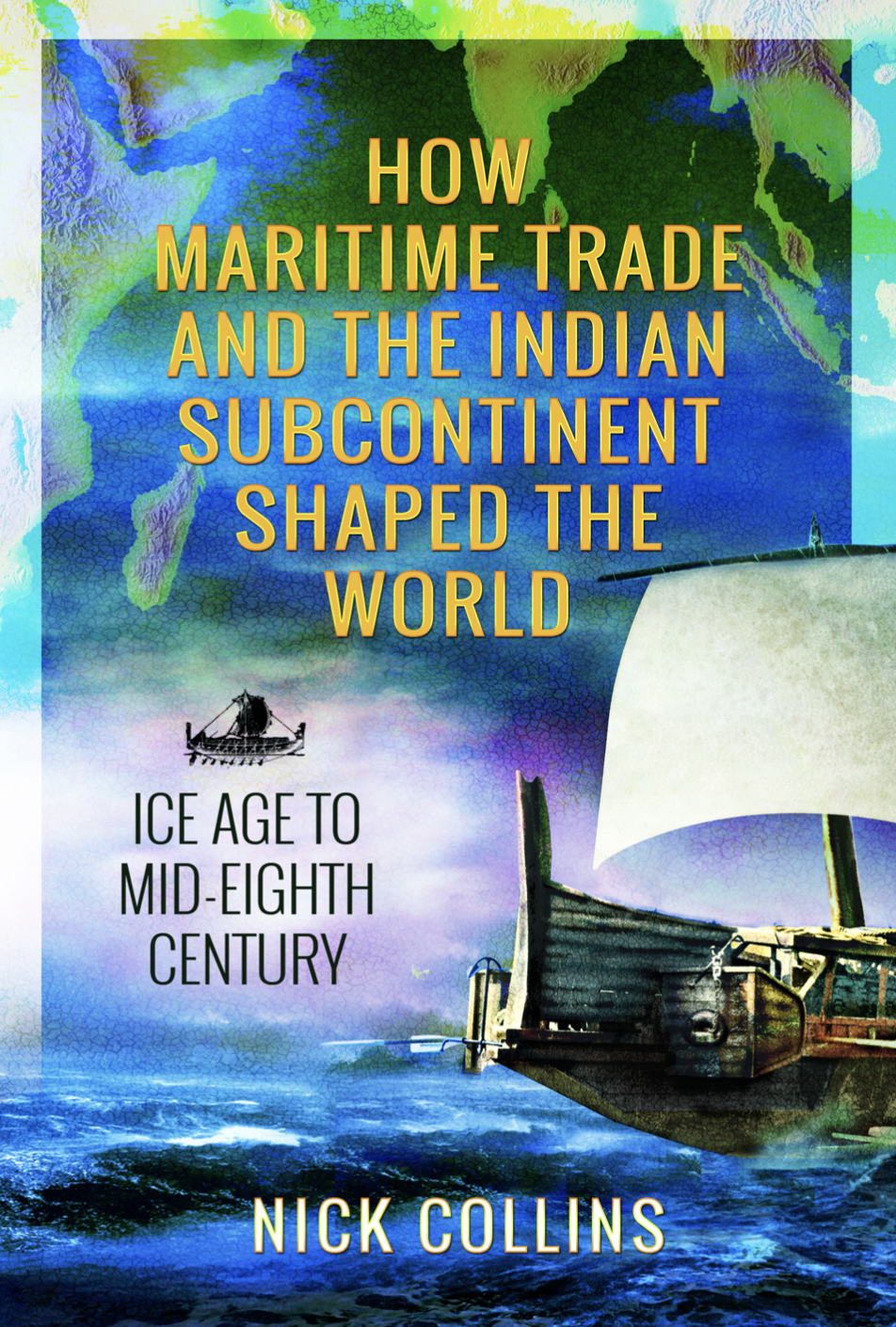
For nearly four decades I worked in the maritime trade world, in London, Tokyo, Singapore and Dubai. This practical knowledge and my history degree inspired my three-volume series on how maritime trade drove world history. The first is How Maritime Trade and the Indian Subcontinent Shaped the World. Ice Age to Mid 8th Century, in which I argue that the subcontinent was the lynchpin of ancient maritime trade in the Ice Age when Europe, northern China and Japan were covered with ice or inhospitable to human activity. The second is The Millennium Maritime Trade Revolution 700-1700. How Asia Lost Maritime Supremacy. Eurocentric histories often side-line India’s contributions but archaeological discoveries and ancient texts when shorn of 19th-century prejudices re-shapes our understanding of the past. Shortlisted for the Mountbatten Maritime Literary Award and widely praised: ‘History with a capital H’- Prof. Geoffrey Till, ‘Clearly a most important work’- Dr Ronald Hyam, ‘fascinating and convincing’- Prof. Malcolm Falkus, among others. Now I have written the third book The Ascent of Maritime Trade 1700-2025. Enlightening the World (estimated publishing date March/April 2026) I am excited to share the first book’s insights with you.
Early Maritime India
The first book dismantles outdated and still mystifyingly peddled myths like the Aryan Invasion of India. Drowned ports in the Gulf of Cambay discovered in 2012, probably dating to the 10th-6th millennium BC contain the first known dockyard. Later, the remarkable Indus-Sarasvati civilisation (c. 3000-1900 BC) traded with Sumer, Dilmun and East Africa, exporting cotton cloth, ivory, pepper, carnelian beads, timber and foodstuffs, importing gold, copper and tin, the first sustained, complex, long-haul trade network, enriching its cities where the Vedas were composed, reflecting millennia of knowledge-gathering and philosophical and scientific enquiry at the exact time of maximum trading and wealth-creation, a feature of all maritime trading nations throughout history. These ideas eventually influenced Mediterranean areas, notably Greece with Phoenicians as its forgotten vectors.
The Trojan War
When the great Sarasvati River dried up, triggering one of the largest migrations of all time, two resulting Indo-European powers, the Greek kingdoms and Troy fought each other in what the ancient Mediterranean world considered the most important event in history, to gain access to the food-rich Black Sea, notably grain and fish. That conventional history has placed this event in 1188 BC rather than about 900 BC obscures cause and effect. The issue is also tackled in detail.
First to Eighth Century in Brief

By the first century AD, the Roman conquest of Egypt triggered a surge of trade through Red Sea ports, enriching the Roman world with medicines, spices, silks and gems, as detailed in the Periplus of the Erythraean Sea, the tax on which in Augustus’ reign financed much Roman imperial expenditure. Tamil literature catalogued the riches it brought to southern India. With enforced long stops in India due to the monsoon, Indian religious ideas were absorbed and taken west with profound influence on Christian ideas, as they had earlier had on Jewish ones from the time of the 10th-century BC Hiram-Solomon treaty which entailed long voyages to India and East Africa with Phoenician navigators and Jewish crew. By the 8th century, Srivijaya’s control of the Malacca and Sunda Straits made it a maritime superpower while Europe was struggling to recover after maritime trade all but disappeared in the 6th and 7th centuries in the wake of Roman collapse in both the Mediterranean and northern Europe. How northern Europe dominated a thousand years later is tackled in The Millennium Maritime Revolution. How Asia Lost Maritime Supremacy 700-1700.
Whether you are an academic, historian, maritime trade professional or curious reader, I invite you to explore the untold story of how maritime trade drove the historical narrative and how some issues because of geography or culture endure still today. The first chapter of How Maritime Trade and the Indian Subcontinent Shaped the World: Ice Age to Mid-Eighth Century is available to read for free on my Substack here.

 Nick Collins
Leave a comment