Out of Africa
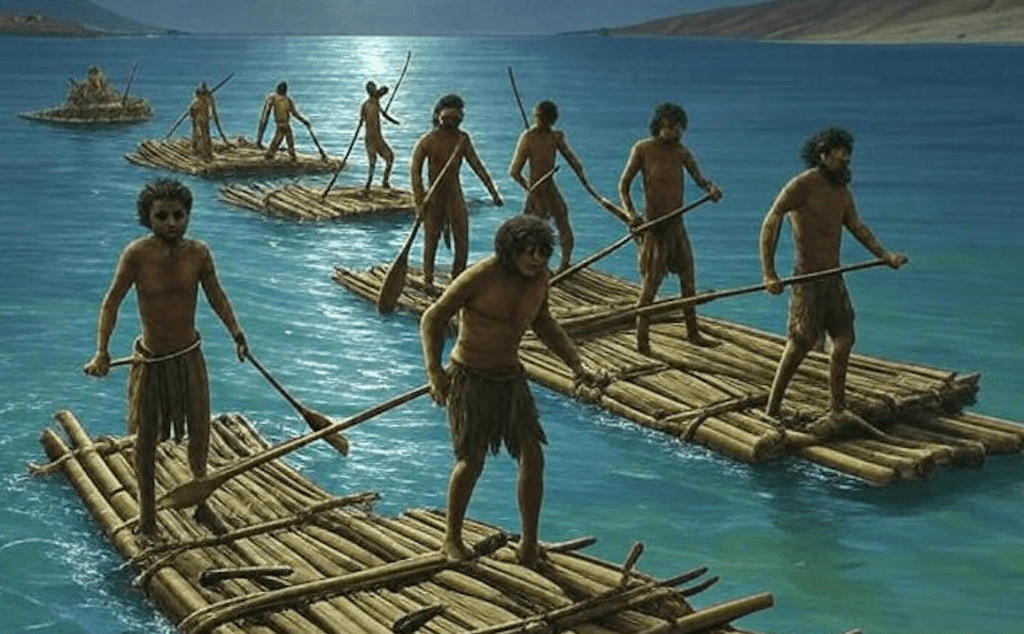
That Homo Sapiens crossed the Red Sea out of Africa about 90,000 years ago, probably in a series of sailings over hundreds of years and spread rapidly across the world is generally accepted. But that maritime trade is perhaps the most important driver of our human story is not yet acknowledged, something I would like to correct (Maritimetradehistory.com). The discovery of hundreds of stone hand-axes in Crete, an island for 5 million years, similar to those crafted in Africa up to 800,000 years ago suggests earlier hominids sailed there 120-200,000 years ago, the huge number of items discovered indicating, purposeful, planned seafaring, an astonishing insight into earlier mankind’s innovative, problem-solving mind.
After exiting Africa (by sea), Australia was colonised about 65,000 years ago. Recently, old theories that America was not colonised until much later have been re-written by archaeological discoveries suggesting more like 40,000 years ago, when sea levels were 120 metres lower, so presumably along the ocean floor ridges from Rapanui to Peru, then a series of islands/atolls. Southeast Asia to southern Japan seem to have been routine.
Mount Padang
The 2012 discovery that Mount Padang in Java is actually a huge man-made step pyramid, topped by megaliths on the uppermost steps, carbon-dated to 14000-23000 BC, although controversial, shows that some Asian communities were very advanced much earlier than previously thought. The step pyramids in South America and mounds in north America, the oldest so far dateable to the 7th millennium BC and Mesopotamian Ziggurats (also step pyramids) in the 5th millennium BC mean the only possible way these ideas diffused was by relatively well-used sea lanes.


In Asia, Tamil temples, pagodas and stupas reflect the step pyramid idea, a reaching up to and communicating with the gods, again brought by intrepid seafarers.


Oldest Ports
The oldest ports discovered by underwater sonar in 2012 in the Gulf of Cambay, west coast India, date probably to the 10th-6th millennium BC which were drowned certainly in the Flood circa 5600 BC, caused by an unlocking of huge amounts of ice in northeast Canada and possibly by an earlier flood in the 10th millennium BC, similarly caused as the Ice Age ended. The latter one is in Indian literature, for example the Mahabharata which describes Dvarka’s ‘beautiful buildings…submerged one by one.’
Indian Ocean to Europe and Japan
Back to Mount Padang, its upper terraces had views of the much taller twin-peaked volcano, 15 miles away, similar to the 7th millennium BC Canal Hoyuk, in today’s Turkey, close to the twin-peaked Mount Hasan. Maritime migration through the Mediterranean and up the Atlantic coast involved food, animals, language, metallurgy and religious ideas, one of which was this sacred mountain idea. The Paps of Danu, two breast-like hills in southwest Ireland, were named after Danu, the Rig Veda’s (India’s oldest surviving text, probably before 4500 BC) Mother Goddess, the energy force. At Beltane in pre-Christian times at the foot of these hills, fires were lit and ashes spread in the fields for good harvests.

So Indian Ocean agricultural festivals were brought to Europe for agricultural plenty and healthy children, some by land via the Indo-European Germanic/Slavic linguistic group but many by sea via the Mediterranean and Atlantic routes. Other ideas like stone representing the dead and wood, life; (as in stone for gravestones, for example) also originate in Indian Ocean lands, as the Ice Age ravaged northern latitudes.
Many other linguistic and cultural similarities and links are detailed in my book How Maritime Trade and the Indian Subcontinent Shaped the World. Ice Age to Mid-8th century. Some Indian influences came later- such as Indian influences to European thought from the 10th century BC and Buddhism to Japan, best seen at Yoshino with some of the largest wooden buddhist temples built in sacred mountain scenery.
The first chapter of my book is available to read for free on Substack. Subscribe to receive new articles.
 Nick Collins
Leave a comment