
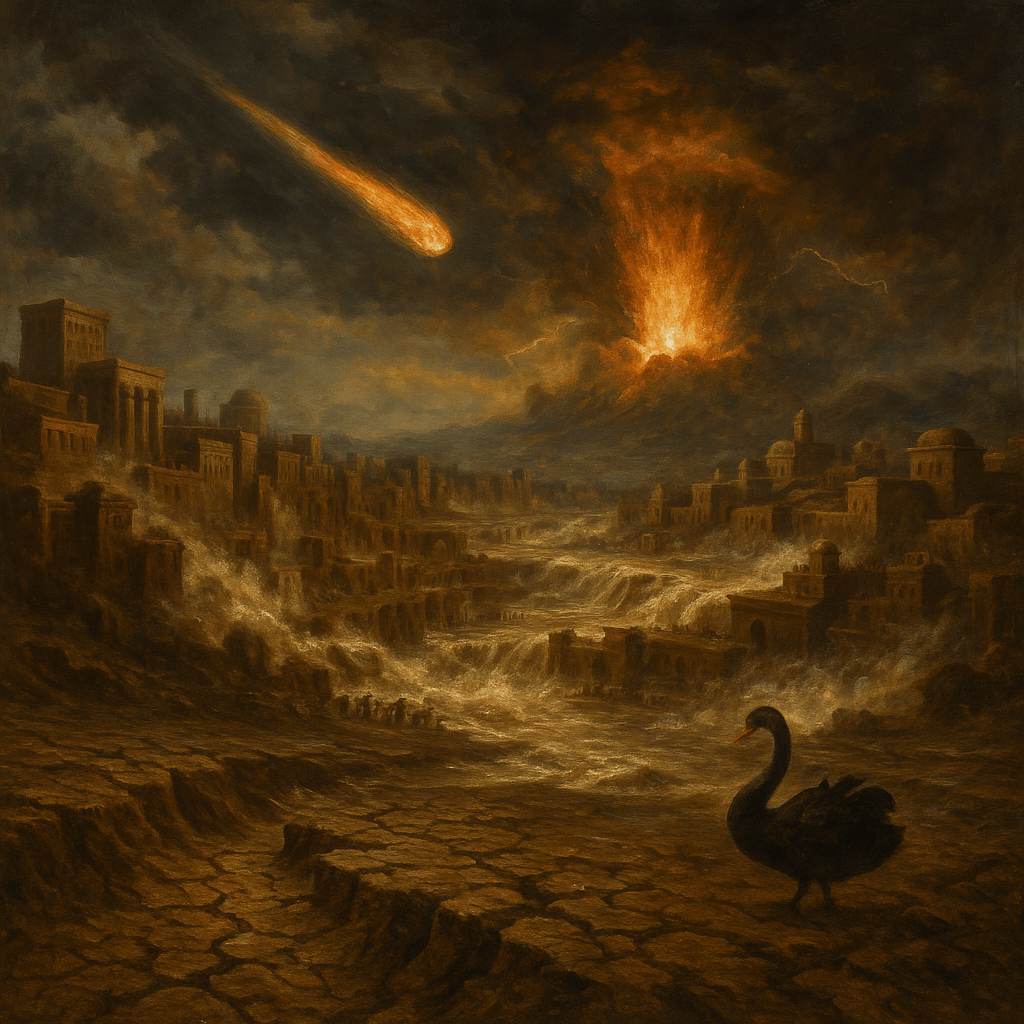
The notion of a “black swan” popularised by philosopher Nassim Nicholas Taleb, describes rare, unpredictable events with profound and often catastrophic consequences. In the annals of ancient history, such events—cataclysmic floods, cosmic impacts, and vanishing rivers—may have reshaped human civilisation in ways we are only beginning to comprehend.
Younger Dryas: A Cosmic Catastrophe?
The Younger Dryas (c. 10,900–9,700 BC), a significant climatic reversal at the end of the Ice Age, has been posited by Graham Hancock as a catastrophe that may have obliterated an unknown ancient civilisation. Likely triggered by a meteor or comet impact, it caused a return to near-glacial conditions, contributing to the extinction of over 35 megafauna species. Hancock suggests evidence of advanced human development earlier than previously assumed, raising intriguing questions. However, its possible location and nature remain unclear, although the impact on human progress of such a catastrophe in warmer regions was undoubtedly devastating.
Deluges of the Ice Age: Submerging Coastal Civilisations
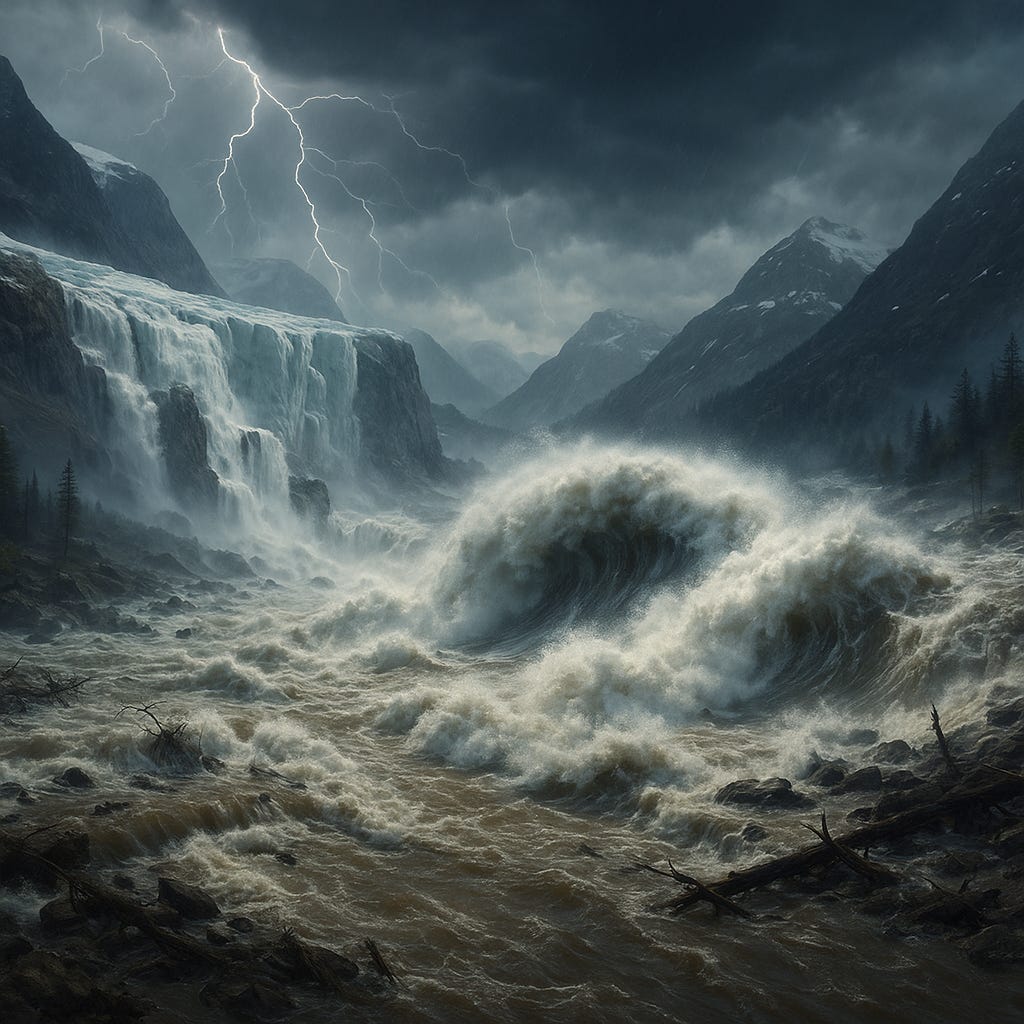
Less controversial are the floods unleashed by the ending of the Ice Age, in about 12000 BC, 9500 BC and 5600 BC– the last one being the biblical Flood and probably the most catastrophic. Caused by the melting of the Hudson Bay and James Bay ice dams, all three increased sea levels by 120 metres. The last caused a tsunami in the Atlantic, the flooding of the Baltic, Black Sea, Yellow Sea, Sea of Japan and Persian Gulf, triggering large migrations by land and sea. 9.65 million square miles of land disappeared. Coastal settlements were drowned. Bearing in mind that coastal settlements have throughout history produced the greatest advances, this was devastating.
Vast regions of East and Southeast Asia, including Sundaland and Mudalu, were submerged by rising sea levels. Recently discovered underwater structures in these areas offer tantalizing clues as to what was lost—potentially a significant civilisation, possibly an offshoot of India’s ancient Vedic culture, given the region’s shallower coastal shelves compared to India’s. The recently identified Mount Padang in Java, an ancient pyramid with underground chambers and soil dated to as early as 24,000 BC, may have been part of this lost world.
In northwest India, two ancient ports, located 30 kilometres offshore in the Gulf of Cambay, were inundated by catastrophic floods. Evidence suggests one port predates the 9,500 BC flood, while the other, constructed farther up an ancient river, was submerged around 5,600 BC. This later site is likely the legendary Dvarka of the Mahabharata. The Bhagavad Gita describes Dvarka as a city of wide avenues and palatial buildings, while the Mahabharata recounts its tragic end: “the ocean…flooded Dvarka, which teemed with wealth…in a few moments it was all over…there was no trace of the city.”
In South India, Tamil traditions preserve accounts of similar deluges. The first Sangam, an assembly of scholars established by Pandya kings, endured for 4,440 years and maintained an extensive library covering governance, trade, ethics, and warfare. A massive flood forced the relocation of surviving texts inland. The second Sangam, at Kavatpuram, lasted 5,700 years but also suffered significant literary losses due to flooding. Survivors relocated to Madurai, where the third Sangam persisted for 1,850 years. While this dating remains problematic, these accounts likely correspond to the floods of 9,500 BC and 5,600 BC, with Sri Lankan manuscripts providing independent corroboration. The 5,600 BC flood also hindered the spread of agriculture across Atlantic Europe.
The Vanishing Sarasvati: Collapse of a Sacred Heartland
The third major catastrophe in ancient history, recognised by early 19th-century British Indologists and geologists but later dismissed as myth by more prejudiced commentators and subsequently underestimated, the catastrophic disappearance of the Sarasvati River was in fact a devastating event with far-reaching consequences.
As the Ice Age drew to a close, rising sea levels coincided with the melting of Himalayan glaciers, giving rise to the Sapta Sindhu, the Seven Rivers, a vast river system in northwest India, which nourished its fertile valleys. This system included the Ganges, Indus, and Yamuna, but the most significant was the Sarasvati, a mighty river two to five miles wide. By 9,000 BC, the valleys of the Sarasvati and its tributaries supported wheat and barley cultivation, fostering a prosperous, inquisitive, and knowledge-gathering urban culture with cities along its banks, predating the well-known successor, the Indus-Sarasvati civilisation ( from circa 3,000 BC), which is often misnamed the Indus or Harappan civilisation due to scepticism about the Sarasvati’s existence, a bias that persists in some circles where the river is still deemed “mythical.”
This extensive river system sustained a population possibly constituting 10% of the world’s total at the time, with the Sarasvati holding such cultural significance that it was revered as sacred, associated with Brahma, the creator deity, and celebrated in the Rig Veda. The Manu Smrti identifies the region between the Sarasvati and Dashadvati rivers as the cultural heartland, while the Rig Veda describes it as “the most holy place on earth in the land of Ila.” In northwest India, a region prone to earthquakes, ancient rivers frequently shifted course, prompting migrations northwest among affected populations. However, around 2000–1900 BC—pending more precise carbon dating—the Sarasvati vanished entirely, likely due to one or a series of earthquakes that redirected its waters into the Ganges. The loss of this river, the cornerstone of the region’s fertility and prosperity, delivered a fatal blow to its economy. The once-thriving cities fell into ruin, and the region transformed into the Thar Desert. This catastrophe triggered mass migrations to the Ganges, which inherited the Sarasvati’s sacred status, as well as to South India, Sri Lanka, and the Middle East. In the latter, Vedic-speaking groups such as the Kassites, Hittites and Mitanni established dominance over local populations, introducing elite Vedic languages and religious symbolism. They introduced chariot warfare and became the great regional powers.
Echoes of a Lost World
These black swan events—the Younger Dryas cooling, the Ice Age floods, and the Sarasvati’s demise—represent turning points in human history. Each catastrophe disrupted thriving societies, forcing survivors to adapt, migrate, and rebuild. While archaeological discoveries and ancient texts provide glimpses of these lost worlds, many questions remain unanswered. What were the effects of the Younger Dryas? What other coastal cultures were erased by the floods?
For a deeper exploration of these events and their global impact, How Maritime Trade and the Indian Subcontinent Shaped the World offers a comprehensive resource. As we uncover more evidence, these ancient catastrophes remind us of humanity’s resilience in the face of the unpredictable, urging us to preserve the lessons of the past for an uncertain future.

 Nick Collins
Leave a comment