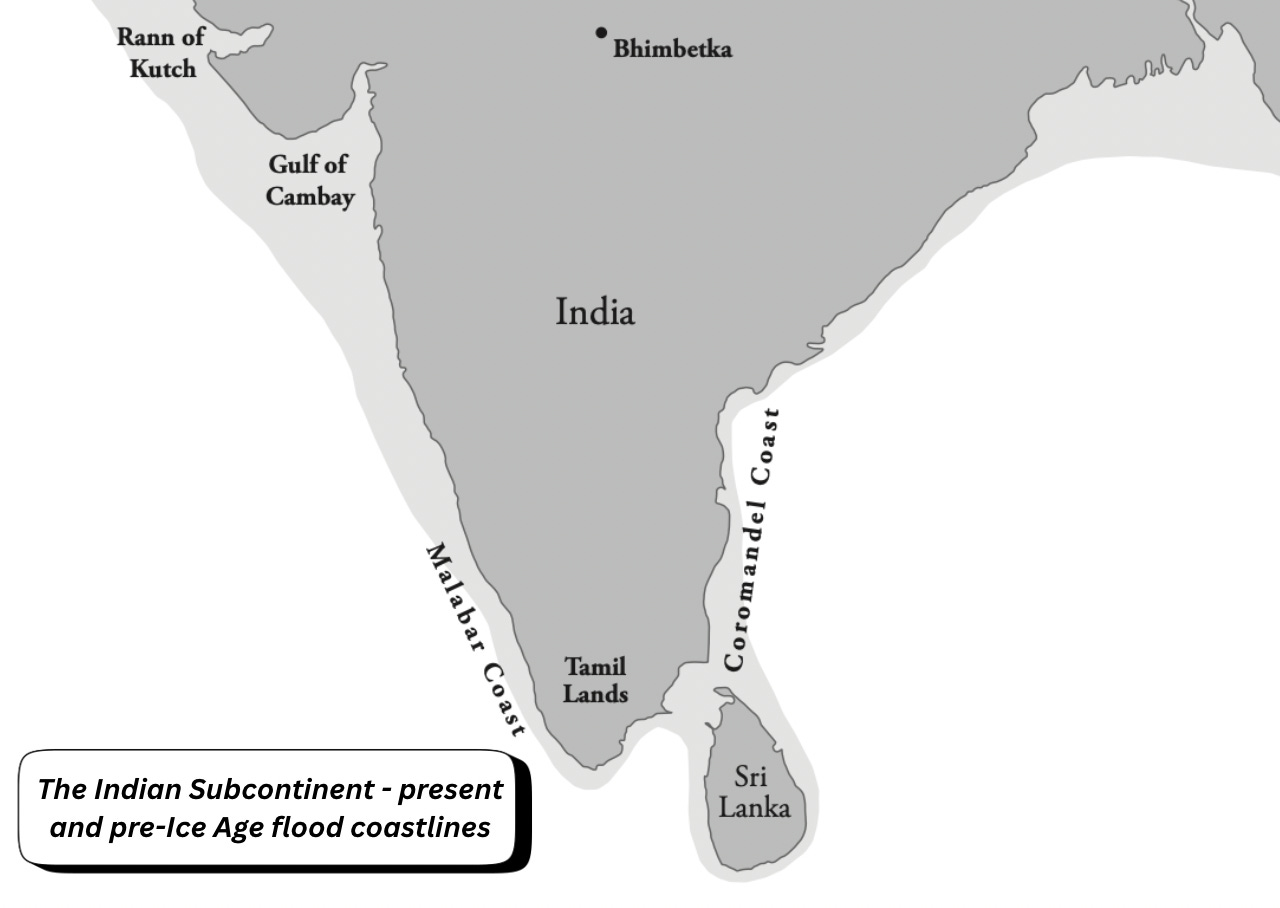
During the Ice Age, significant human development was largely confined to regions bordering the Indian Ocean, characterised by temperate, balmy, or Mediterranean climates, yet dominated by monsoons. These conditions fostered early cultural advances in a region uniquely suited for human progress.
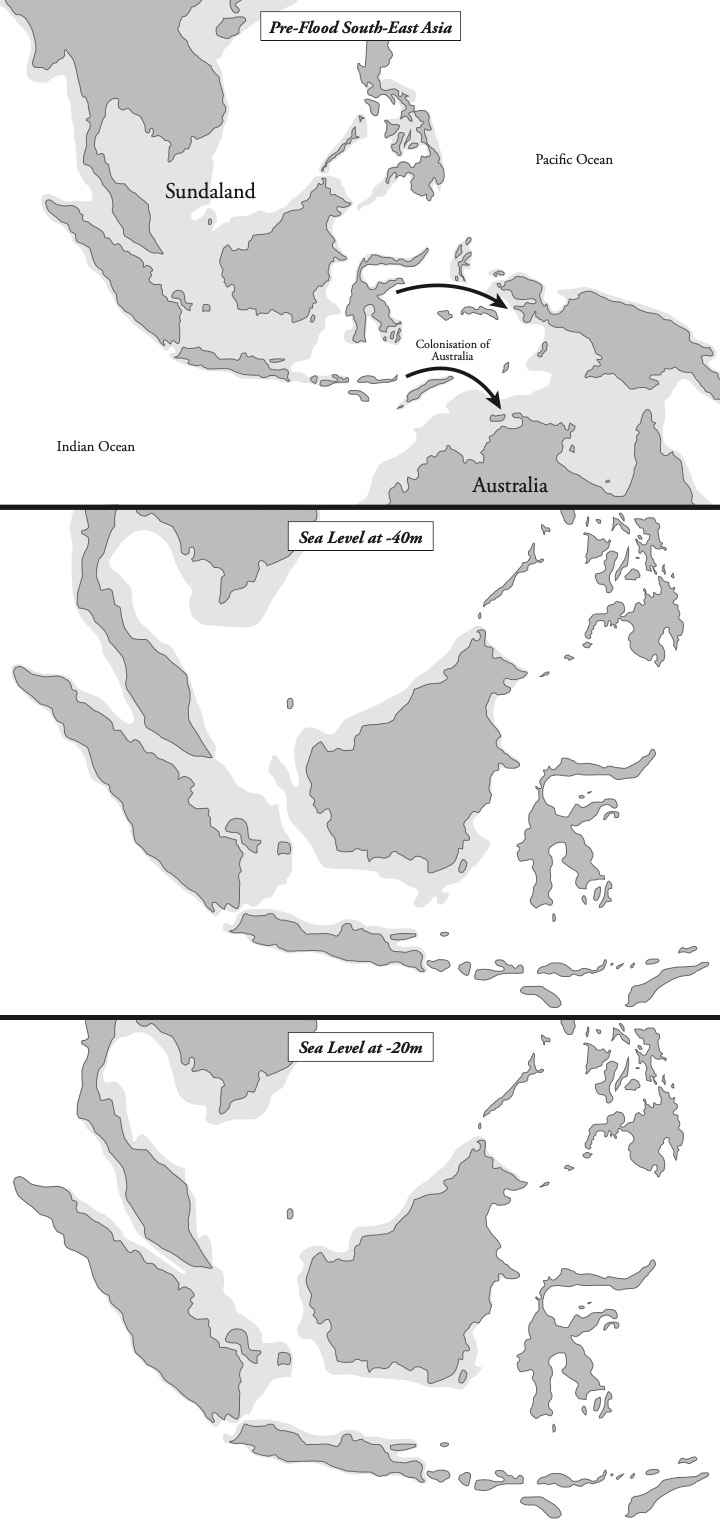
The dominant landmasses included the Indian subcontinent, Sundaland (now the Indonesian archipelago), and an extended region of Southeast and East Asia known as Mu or Mudalu.
Submerged Worlds
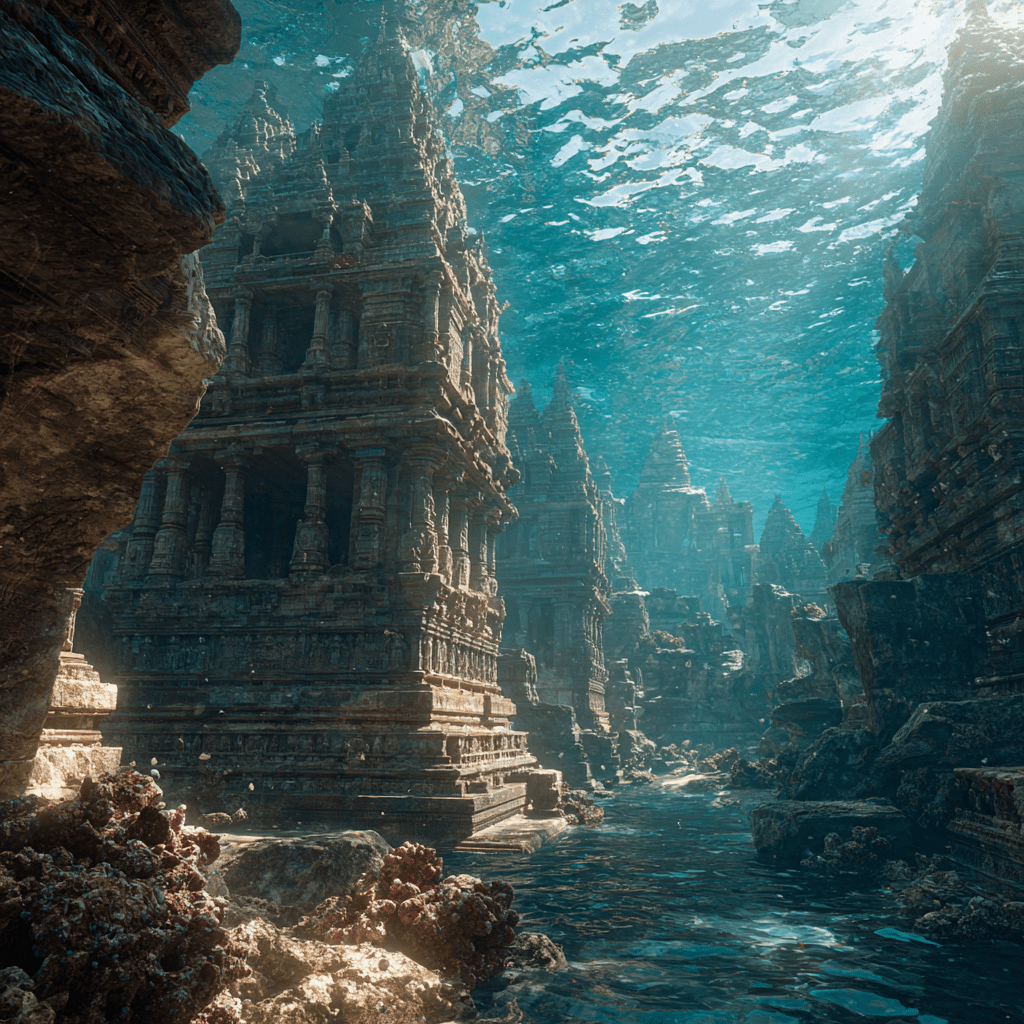
The shallow continental shelves of Sundaland and Mu led to their submersion as sea levels rose. Recent discoveries of underwater structures offer a tantalising glimpse into an extensive early megalith-building culture, with much still to be explored.
In India, the legendary port of Dvarka was submerged, rebuilt, and submerged again, rediscovered offshore in the Gulf of Cambay in 2012. Dvarka represents the earliest known port with recognisable features like commercial zones and ship slipways. In the southeast, Tamil records document the relocation of their Sangam library twice, corresponding to massive ice melts that flooded the Indian Ocean around 9500 and 5600 BC, the latter immortalised as The Flood in the Bible.
Seafaring Pioneers
Seafaring humans from the Indian Ocean reached Australia approximately 60,000 years ago. Previously, it was believed that humans arrived in the Americas only 13,000 years ago via the Bering Strait. However, evidence now suggests human presence in the Americas as early as 40,000 years ago, facilitated by lower sea levels (120 meters below current levels) that allowed island-hopping across the Pacific. This finding carries profound implications.
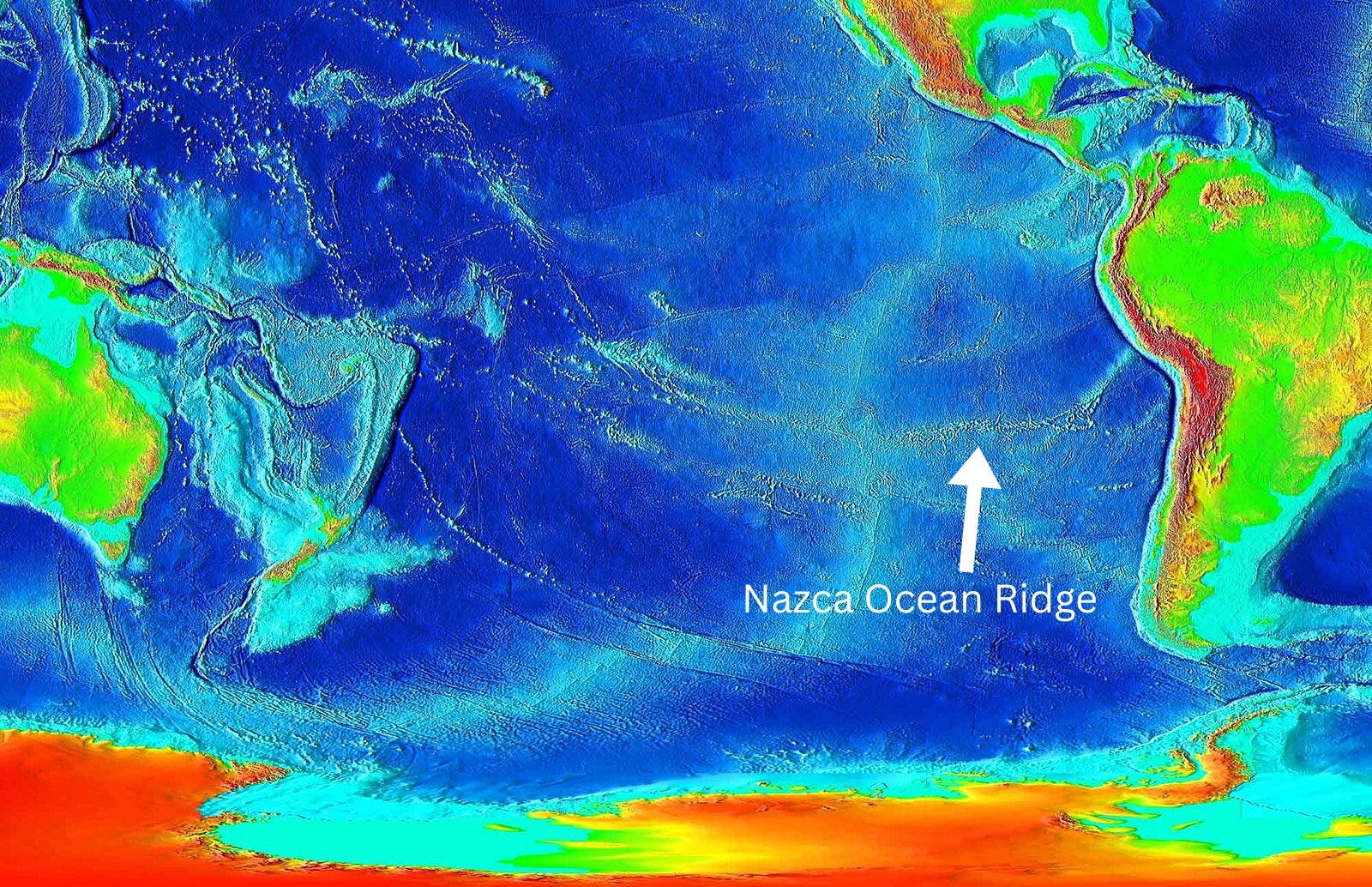
The likely entry point to the Americas was via Rapanui (Easter Island), along two now-submerged ocean ridges that once formed a chain of atolls and islands extending to Peru. Consequently, the post-Flood Lapita expansion, once thought to be the initial colonisation of uninhabited Pacific islands, appears to have been a secondary wave. Mysterious platforms on some islands may be remnants of the so-called ‘Before people,’ as described by local inhabitants.
Foundations of Maritime Trade
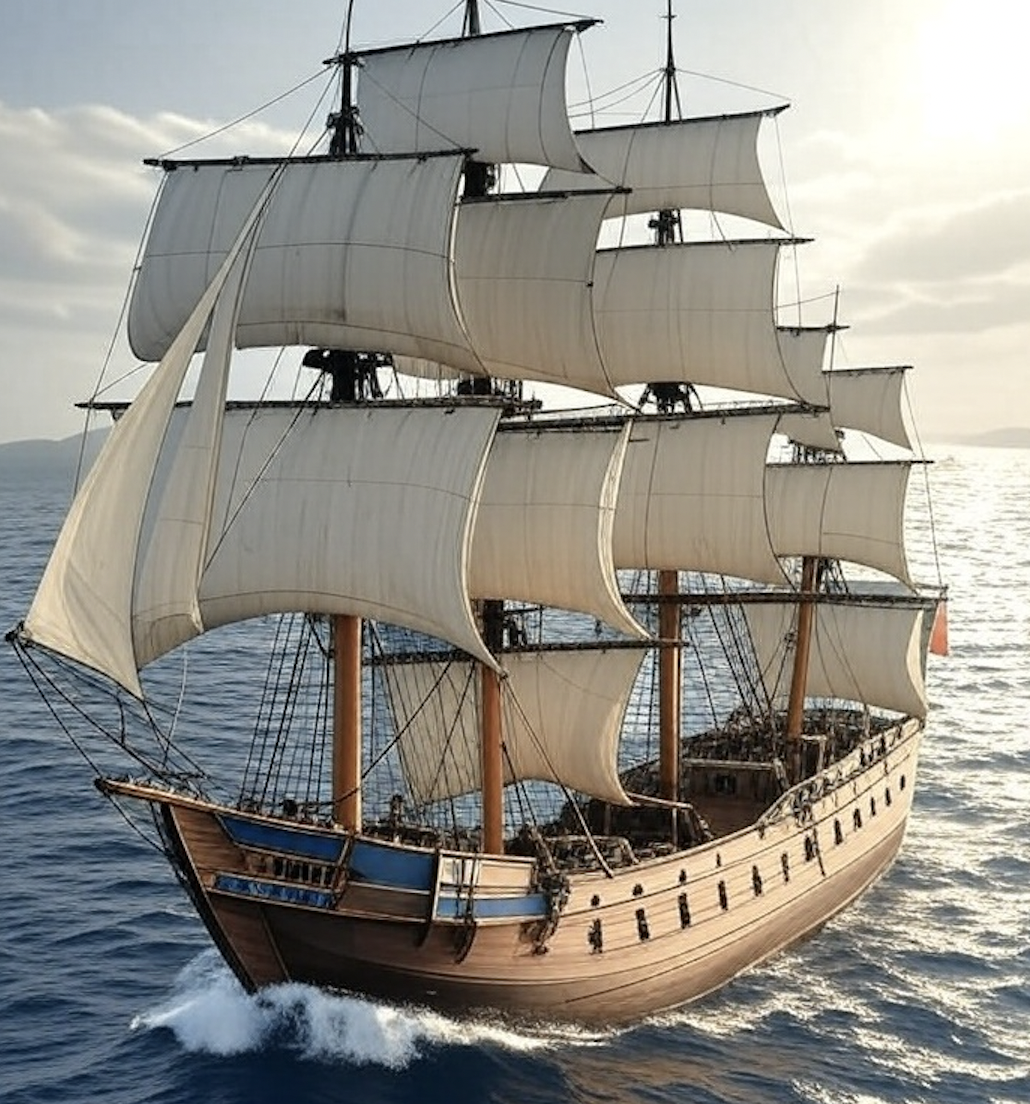
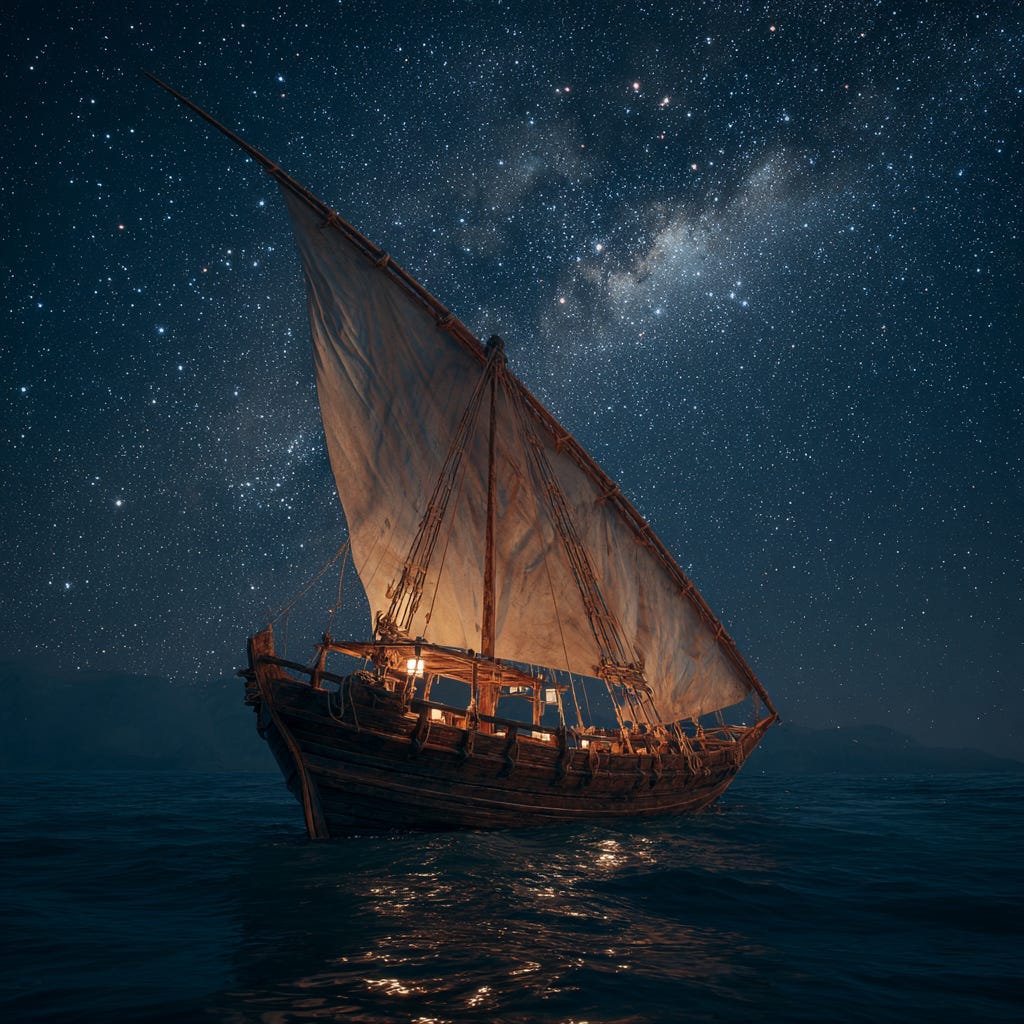
Seafaring and maritime trade laid the groundwork for advanced economic and intellectual pursuits. These activities demanded practical problem-solving, including mastering buoyancy, preventing water ingress, provisioning for extended voyages, designing oars, sails and hulls. Navigators studied winds, waves, currents, and the behaviors of seabirds, whales, and fish, systematically collecting and transmitting knowledge.
Tracking the positions of stars across seasons required centuries of observation. Merchants needed literacy, numeracy, and proficiency in foreign languages, laws, customs, weights, measures, currencies, and market preferences, as well as skills in assessing prices, credit, and risks. These practices marked the transition from mere knowledge accumulation to active knowledge pursuit, forming the bedrock of civilisation. This began in the Indian Ocean while ice blanketed northern latitudes and the Mediterranean saw little significant seafaring. Notably, on Crete, stone tools dated in Africa to 120,000–800,000 years ago suggest purposeful arrivals by pre-Homo sapiens species, though their impact was limited compared to the Indian Ocean’s achievements.
Indian Ocean Intellectual Legacy
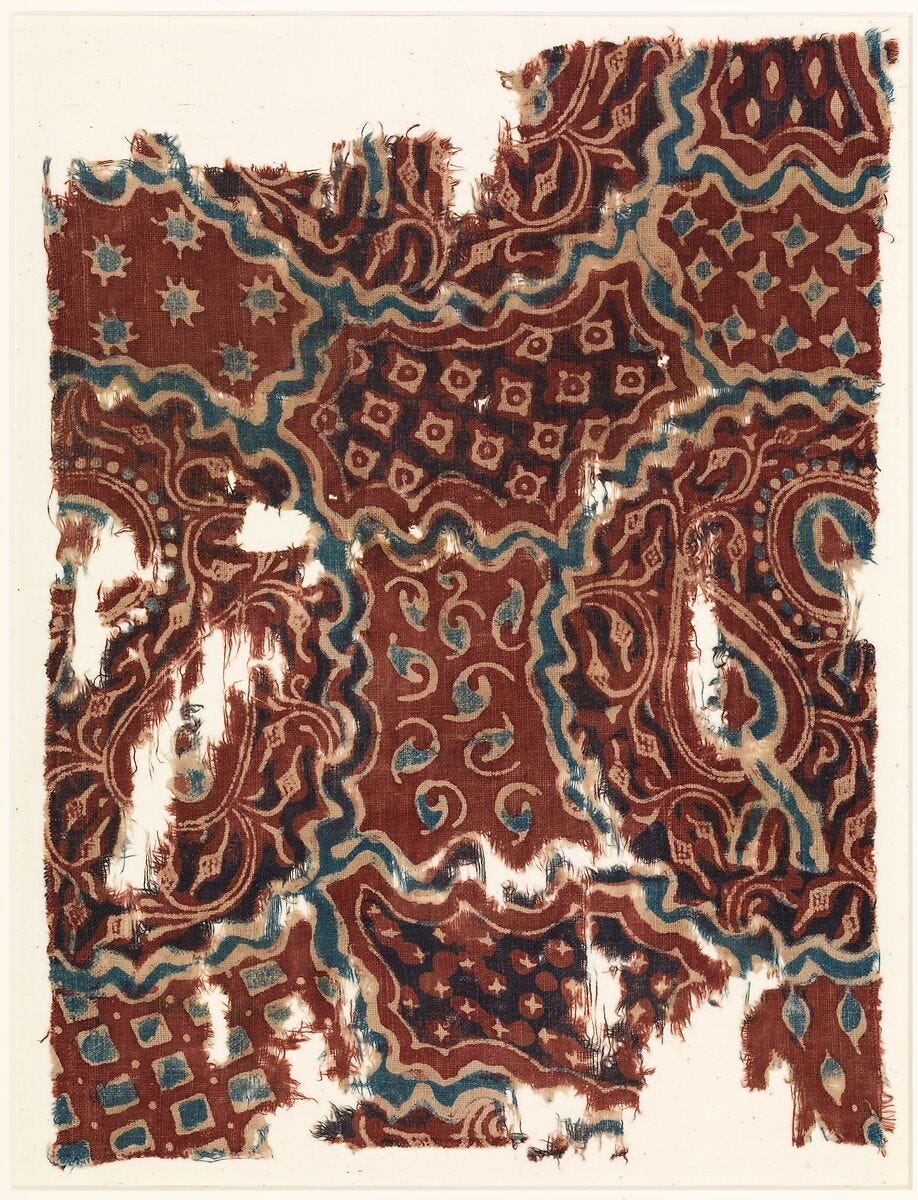
The zenith of Indian Ocean influence, extending into the Pacific, is evident in the ancient literature of the Indian subcontinent. The Vedas and their derivatives in northwest India, alongside the Tamil Sangam literature in the south, chronicled history, geography, environmental conditions, political structures, medicine for numerous ailments, male-femal relationships, astronomy, mathematics, altar design, and more. These texts were continuously updated with new discoveries. To convey nuanced meanings, scholars developed Sanskrit, an artificial language. Indian craftsmanship flourished, mastering techniques like the lost-wax method for bronze casting, painting, and vibrant textile production using natural dyes abundant in Indian Ocean regions.

Post-Ice Age Trade Dynamics
After the Ice Age, Europe and East Asia began to be populated but remained less advanced than the Indian subcontinent, which supplied Mesopotamia with food, spices, timber, and manufactured goods. The imbalance in maritime trade – Mesopotamia offering only woolen textiles and re-exported Anatolian metals – prompted Uruk’s invasion of Egypt, establishing its first Pharaonic Dynasty to access gold, ancient India’s currency of choice. This gold, mined and traded through Ebla and Mari to the Persian Gulf and ultimately India, financed the goods essential for Mesopotamian civilisations.
Global Appetite for Indian Ocean Goods
When Rome annexed Egypt, Roman demand for Indian Ocean commodities boomed. Trade, previously handled by a few dozen ships annually, expanded five- to six-fold, primarily paid for in gold. Vasco da Gama and the English East India Company (EIC) encountered similar demand. Initially focused on spice imports from Southeast Asia, the EIC shifted to India after the Dutch dominated the spice trade. They found India’s cotton-working skills, dating back to at least the 7th millennium BC, far surpassed European textiles in technical and artistic quality. The rich biodiversity enabled multiple dye colours. This environment and the industrious people in the Indian Ocean, especially India, consistently drew European interest, a legacy rooted in its Ice Age origins.
Reassessing Historical Narratives
Eurocentric histories have long obscured these geographical realities. However, open-minded Western scholars, alongside their Indian counterparts, are now acknowledging the Indian Ocean’s pivotal role in early civilisation and working to correct the historical record. Much more, however, remains to be explored and understood. Further details can be found in How Maritime Trade and the Indian Subcontinent Shaped the World. Read the first chapter on Substack here.
 Nick Collins
Leave a comment