Buy from: Amazon| Pen & Sword | Garuda (India)
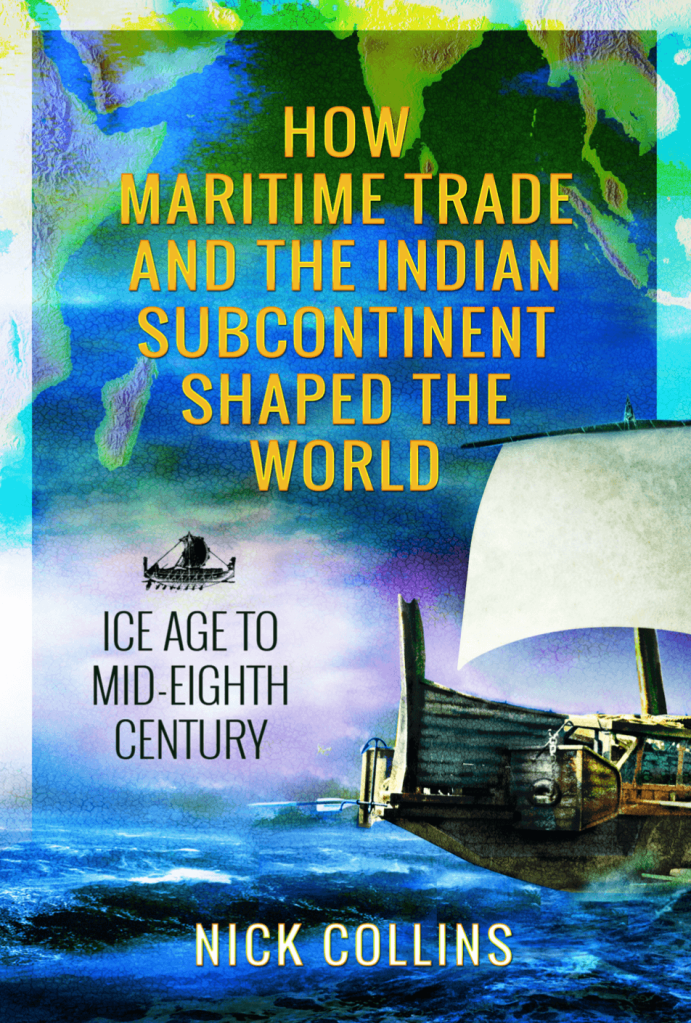
When much of Europe and northern Asia was covered with ice or was inhospitable, Indian Ocean maritime connectivity shaped the world. After the Flood (c. 5600 BC) the first sustainable, long-haul, complex trade routes forged kingdoms and empires, pushing into the Mediterranean. Jain and Phoneician merchants brought not just goods but Indian ideas to Greece. The Trojan War – the most famous event in the classical world – was caused by need to access Black Sea grain. Victory ensured food security for Mediterranean civilisations. Egypt partly replaced it as Rome’s main granary. From there taxes on Indian trade in spices, gems, pearls and medicines bankrolled its 1st-century Empire, only to disintegrate from the mid-2nd century as Europe’s ports crumbled. Indian Ocean maritime vibrancy continued. Shortlisted for the Mountbatten Maritime Literary Award, Nick Collins uses archaeology, history and literature to show how trade routes were as much the lynchpin of the ancient world as they are of the modern. Read the first chapter in full on Substack.
Plaudits and Quotes
‘Remarkable and fascinating…History with a capital H…the author’s capacity to make effective use of archaeological and scientific data, alongside the economic, cultural and linguistic is impressive…a remarkable achievement well worth investigating…this reviewer will be looking forward to the appearance of the next two volumes…definitely recommended.’ Professor Geoffrey Till, The Naval Review
‘I am utterly astonished by it…clearly a most important work…the control of detail is remarkable…most enlightening.’ Dr Ronald Hyam
‘This book deserves to be widely read…fascinating and convincing…written with skill and enthusiasm…makes rather complex topics both interesting and coherent…both remarkable and more importantly enjoyable.’ Emeritus Professor Malcolm Falkus
‘Well written and informative…While I can single out many other issues and topics the thing that impressed me the most was [the] attempt to put India on the map of world history.’ Alfons van der Kraan
An epic tome that sets out to put merchant history at the centre of world history…an interesting work, ambitious in scale but accessibly written and divided into manageable chunks…and will surely encourage readers to read…his upcoming books covering later periods…Nautilus Book of the Month for September 2022.’ Nautilus International
‘Well written…very readable…the author has done a good job in tackling such a large subject, breaking it down into the relevant parts…vast amounts of information…the author is to be congratulated.’ ARRSE Review
‘A broadly-based and exciting account…for general readers, specialists and practitioners…with an attractive writing style and full of fascinating sidelights illuminating the historical narrative [from]…an author with life-long experience in international shipping.’ SAFETY4SEA

Buy from: Amazon| Pen & Sword | Garuda (India)
In 700 Europe’s maritime trade was struggling to recover from its 6th-7th century wipeout, while Indian ocean trade surged eastward, birthing Srivijaya’s choke-point empire and Song China’s unmatched civilisation. By 1370, Asia’s maritime lead seemed unassailable. Yet, flawed policies in Asian states and Europe’s stuttering re-embrace of maritime trade led by Venice, Genoa, Bruges, London, Antwerp and Amsterdam meant that by 1700 European shipping worldwide was either dominant or ascending. Nick Collins, a Cambridge-educated maritime veteran, charts this dramatic reversal, revealing how trade policies forged or felled empires. Packed with insights from ancient texts and port rivalries, this volume unveils the roots of modern commerce. Perfect for history buffs and trade experts, it’s a tale of ambition and missteps.
Plaudits and Quotes
Ambitious and strikingly well informed…based on an impressive range of scholarship. It makes connections across fields of enquiry that are rarely, if ever, linked…it is also a timely text, coming as it does when Asia has recovered the dominion it once exercises over global maritime trade.’ Professor Andrew Lambert
‘An original incursion into and explanation of a topic that warrants examination…broad and ambitious and…compares very well and strongly with other recent popularized publications in the field.’ Professor George Bryan Souza
‘Why maritime history is everyone’s history…Collins uses meticulous research and engaging storytelling to highlight the pivotal role of maritime history in shaping world events [and] employs a diverse collection of sources to provide a comprehensive understanding of this transformative period.’ Nautilus International
‘Fascinating fact-lets jump out at you from every page…This is someone clearly familiar with today’s trading system, who really, really knows his stuff…The author’s sheer enthusiasm for this vast subject is truly inspiring-in the sense of making the reader want to know more. And that’s not something reviewers often say about other peoples’ books.’ Professor Geoffrey Till, The Naval Review
Refreshingly, this is a global history that does not centre around European successes and failures but provides a primary viewpoint from Asia looking towards Europe…the text provides an exceptionally rich array of case studies with many fascinating details of what was traded and how merchants and commodities operated across time…this is an engaging, well-written story of the supremacy of maritime trade in shaping world history. Marion Uckelmann, New Book Chronicle. Cambridge University Press 29/10/24
 Nick Collins